
Amid the political and territorial uncertainty that the newly independent India was reeling from, the Indian Air Force, still in the early years of its making, was preparing for yet another war-like situation over Kashmir. Tensions between India and Pakistan came to a head.
It was the October afternoon of a crisp autumn in 1951 when the IAF, nowhere nearly prepared to face a war, pulled off one of the fastest and least touted combat expansions in its history. And just like that, the most ferocious, tactical and decorated combat unit- Squadron 17- was born.
Urgency gave birth to Squadron 17, now also known as the ‘Golden Arrows’. By mid-1951, when a war between India and Pakistan looked imminent due to growing tensions in Kashmir, troops were constantly being mobilised; but the Indian Air Force was clear of any illusion – the existing force structure was not enough.
The force knew that waiting for government approvals would be catastrophic for India, and hence the IAF decided to act, preparing “emergency units” in anticipation of future approval.
The IAF created combat units on paper with limited resources, aircraft, and very few personnel. The understanding was that they would use whatever aircraft were available or borrowed from elsewhere. IAF historian Achint Gupta describes these formations as India’s “Emergency Teens”.
On August 15, 1951, two new units – Squadrons 14 & 15 were formed. On September 16, Squadron 16 followed, and finally, on October 1, 1951, Squadron number 17 was raised. The IAF had expanded by 40% in just under eight weeks – even if only nominally.
Squadron 17 was formed under the command of Flight Lieutenant DL Springett and was initially based at Punjab’s Ambala and designated for a particular role – tactical reconnaissance.
While the unit’s development and contributions over time are among the most inspiring legends anchored to the Indian Armed Forces, its rising combative capabilities and arsenal are what need to be talked about today.
The humble beginnings
While the IAF nominally created several combat units, running them was a different ballgame. With no aircraft production ecosystem and a dire shortage of spares, the IAF was forced to leverage its training establishments. Harvards, Tempests, and a dwindling stock of Spitfire XVIII aircraft were hurriedly pulled from training use and reassigned to these new units.
The initial aircraft assigned to No. 17 Squadron was Harvard IIB. At its inception, the unit’s authorised aircraft strength was 12 Harvard IIB trainers, but availability was a constant issue. As of September 1952, only four aircraft were actually delivered to the unit. Even these were stretched thin across conversion flying, tactical drills, and administrative ferrying.
Rapid command turnovers
For Squadron 17, impediments were hardly confined to operational and military shortages. The squadron’s first year witnessed frequent command changes. Flight Lieutenant GCVS. Nallayya (2770) GD(P) took over from Springett on September 1, 1952, and then Flight Lieutenant KNM Panicker assumed command on December 3, 1952. This repeated change in leadership reflected the broader uncertainty surrounding the squadron’s future and role.
One of the biggest setbacks for the unit came in January 1953 when the squadron dwindled to just two Harvards, of which one had exceeded its maximum flight hours and was awaiting disposal to No. 1 BRD.
Even after the approval of a re-equipment plan in April 1954, which authorised 16 Vampire Mk.52 fighters and two Vampire T.11 trainers for the unit, their conversion remained painfully slow. By mid-1955, No. 17 Squadron had just five Harvards, only two of them airworthy. As a reconnaissance unit, it also lacked essential airborne cameras and photo-mapping equipment, leaving aerial-photography training largely theoretical.
For the unit, a breakthrough finally arrived in September 1955, when the squadron received seven Vampire Mk.52s, one T.11 trainer and a surviving Harvard. The arrival of the jets transformed its operational capability, leading its pilots to stand alongside the IAF’s frontline fighter units for the first time. The ageing Harvard was soon retired, closing a difficult but defining chapter in the squadron’s evolution.
Yet No. 17’s experience reflected a wider problem. Although the IAF had raised four squadrons under emergency conditions in 1951, formal government approval to expand to a 15-squadron force came only in December 1953, and it took until March 1957 for the new squadrons to become fully staffed, equipped and operational.
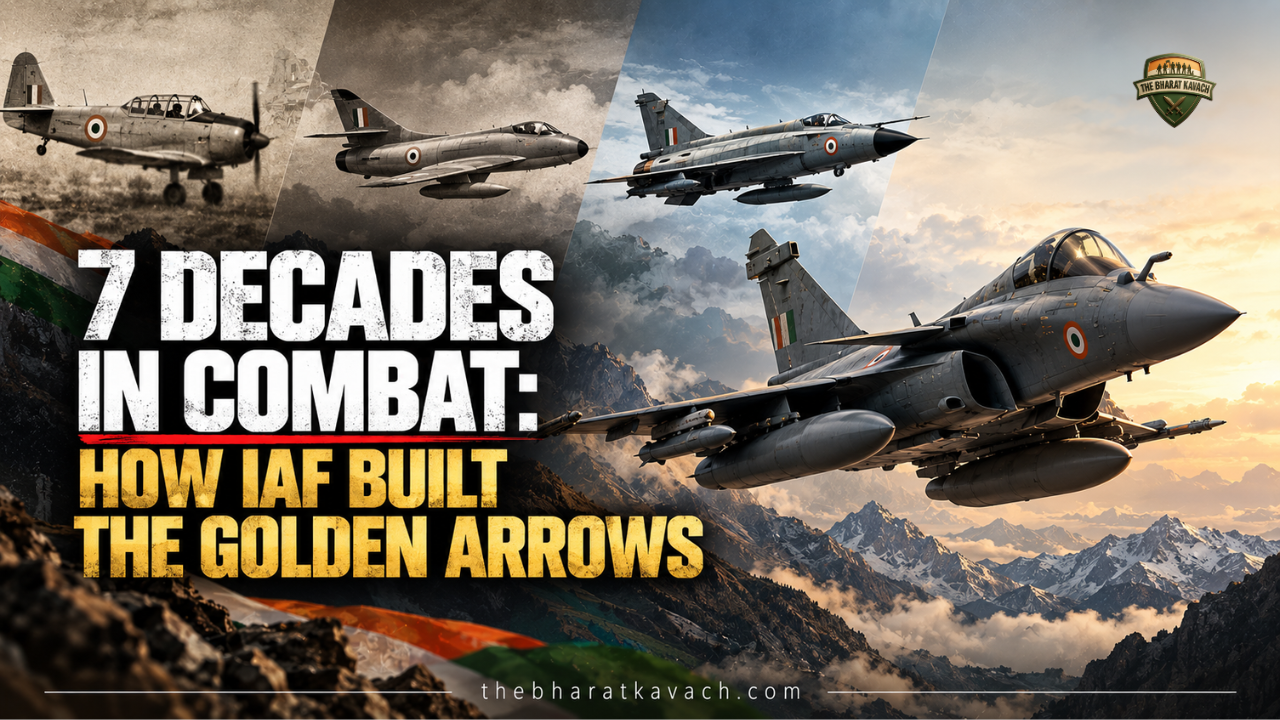
Aircrafts used by Squardon 17 over the years
Harvard IIB (1951 – 1955)
Harvard IIB were the two-seat military trainer used for tactical reconnaissance during the squadron’s early operational years.
de Havilland Vampire FB52 (1955–1957)
No. 17 Squadron (“Golden Arrows”) of the Indian Air Force operated the de Havilland Vampire FB 52 from October 1, 1955, until September 1, 1957.
Hawker Hunter (F56 & T66) (1957–1975)
A swept-wing British fighter jet utilised heavily in historic conflicts, including the 1961 Liberation of Goa.
MiG-21M (1975–2016)
The unit used this primary supersonic fighter jet for decades. Under this configuration, the squadron actively participated in the 1999 Kargil War (Operation Safed Sagar) before being temporarily number-plated/disbanded in 2016.
Dassault Rafale (2020–Present)
Following the squadron’s resurrection in September 2019, it became the first IAF unit to be equipped with the 4.5-generation French multi-role fighter Rafale jets.
Kargil War to Operation Sindoor: 7 decades in combat
Squadron 17’s first major combat deployment was in 1961 during the Goa Liberation Campaign. By then, the squadron was flying Hawker Hunters, and on December 18, its aircraft conducted attacks against Portuguese positions in Goa. Historical accounts suggest that the unit, stationed at Sambra near Belgaum, launched rocket attacks at Portuguese military positions, and this earned them a well-deserved promotion from a relatively young fighter unit to an operational combat unit.
The Ministry of Defence officially records No. 17 Squadron’s participation in the Goa Liberation Campaign.
Their next big stint was the 1965 India-Pakistan War, but this was a different kind of engagement for the Golden Arrows. The squadron was deployed in the eastern theatre and primarily operated as a reserve force rather than undertaking offensive operations.
Six years later, the squadron entered full-scale combat during the 1971 India-Pakistan War. Operating from the eastern theatre, No. 17 Squadron flew close-air-support, counter-air and fighter-reconnaissance missions. As per the government records, the unit reportedly flew 18 counter-air and close-air-support sorties, leading a formation of Hunters engaging Pakistani F-86 Sabres on the opening day of the war. Two Pakistani Sabres were shot down without loss to the squadron in that engagement.
The squadron’s most defining wartime chapter came during Operation Safed Sagar in the 1999 Kargil War. By then operating MiG-21s, the Golden Arrows undertook reconnaissance and strike missions in extremely demanding high-altitude conditions near Kargil.
One of its most recounted accounts is of Squadron Leader Ajay Ahuja, who took off from Srinagar on May 27, 1999, to locate the wreckage of a downed MiG-27 and assist in the rescue of its pilot, Flight Lieutenant K Nachiketa. Ahuja’s MiG-21 was subsequently hit by a shoulder-fired missile, and he was killed.
In this operation, the squadron also adapted its bombing techniques for the unusual atmospheric conditions of high-altitude Kargil; according to former commanding officer BS Dhanoa, the unit developed new calculations for weapon release and subsequently conducted strikes against targets including Peak 5140.
The IAF later recognised the squadron with multiple honours, including a Vir Chakra awarded posthumously to Ahuja.
After its resurrection in 2019 and conversion to the Rafale, the Golden Arrows entered a new era of operations. Squadron 17 became the IAF’s first Rafale-equipped unit, with the aircraft formally inducted in September 2020. More recently, reporting on the squadron’s 75-year history records its participation in Operation Sindoor.
During Operation Sindoor in 2025, the squadron’s Rafales were part of the IAF’s response, according to former Air Chief Marshal BS Dhanoa, as reported by The Indian Express.
