

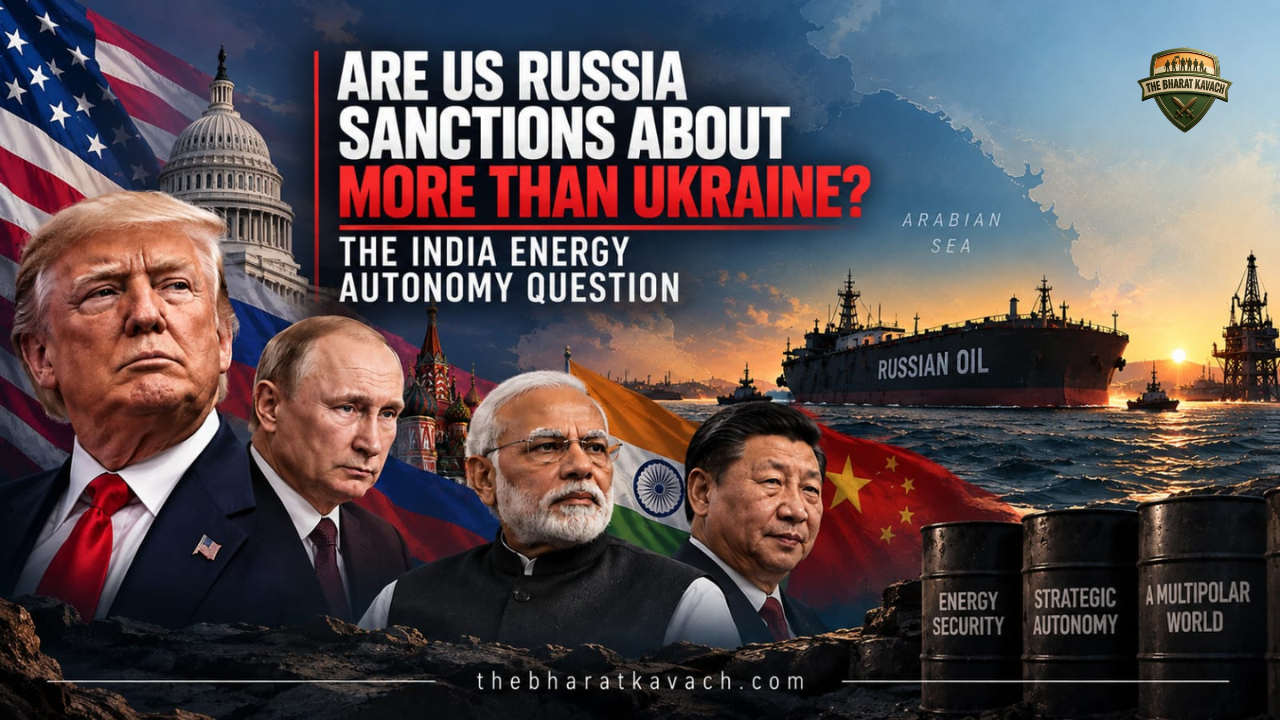
The US House of Representatives on September 16 passed the Lindsey O. Graham Sanctioning Russia and Iran Act of 2026 by 262–159. Two days later, President Donald Trump signed the legislation into law, giving the US administration new authority to impose tariffs of up to 100% on qualifying countries that continue to purchase significant quantities of Russian crude oil or natural gas. India and China, among the world’s largest buyers of Russian oil, are therefore at the centre of attention.
The legislation, as stated in the official bill, is primarily designed to increase pressure on Russia over the Ukraine war. It targets Russia’s energy and defence sectors, sanctions-evasive vessels and other parts of Moscow’s economic infrastructure, while creating a mechanism to put pressure on top purchasers of Russian energy.
But within hours of the House vote, India made its position clear.
The MEA said it remained “firmly committed” to ensuring energy security for 1.4 billion Indians and would continue sourcing energy from diverse suppliers based on evolving market conditions. It also said India had already discussed the potential implications of the bill with US interlocutors at senior levels and had clearly communicated the possible consequences for both bilateral relations and international energy markets. New Delhi added that it would take all necessary measures to protect its trade and economic interests
On the face of it, this legislation looks like another development in the Russia-Ukraine sanctions story, but there are larger questions worth examining:
Why has Russian oil become such an important point of friction between Washington and New Delhi? Is it just about stopping the Ukraine war? Or could the energy crisis that emerged after the disruption of the Strait of Hormuz have exposed a limitation in the ability of the US to influence the energy choices of major Asian powers?
The India-China angle: A clear target
The American argument around the bill is relatively straightforward.
Russia’s energy exports generate a substantial portion of the revenue that supports its ability to sustain the war in Ukraine, and the Western sanctions have therefore attempted to restrict Russia’s access to technology, finance and energy markets.
But there is an obvious limitation.
Sanctioning Russia becomes nearly pointless if other major economies continue to purchase its oil, and that’s where India and China come into the picture. In this bill, the pressure is no longer directed only at Russia.
It potentially extends to Russia’s customers, and at this juncture, India’s energy-security moves begin to collide with Washington’s Russia strategy.
The new legislation creates a mechanism through which the US can impose tariffs of up to 100% on goods imported from countries that meet specified criteria related to Russian oil and gas purchases or sanctions evasion.
The passed bill gives the executive branch flexibility to identify countries through the “top five” criteria.
Meanwhile, the political intent of the bill was made even less ambiguous after Senator Richard Blumenthal’s comment. “To China and India: You better clean up your act. Buy your oil and gas somewhere else.”
Notably, the legislation does not automatically impose a 100% tariff on India or China; rather, it gives the President the authority to impose such tariffs on qualifying countries. The measure also includes presidential waiver provisions.
Decoding India’s response
There is an important detail in New Delhi’s response that deserves attention.
The Indian government did not present its position as a new reaction after the Graham Act; rather, it explicitly reiterated its existing stance.
India said that, as it had stated on earlier occasions, its priority remained energy security and that it would continue to diversify its sources according to market conditions.
It also said that the potential implications of the US measures had already been discussed with American interlocutors in recent months. That distinction matters.
India is essentially saying that its Russian oil purchases should be understood through the broader question of energy security, rather than solely through the geopolitical question of Russia’s war in Ukraine.
The disagreement with Washington, therefore, is not simply over Russia.
It is also about who gets to determine the acceptable limits of India’s energy choices.
Trump’s continued pressure, India’s resilience
This tug of war has existed for some time as Washington repeatedly sought to reduce India’s purchases of Russian crude while India continued its transactions.
In 2025, the Trump administration imposed an additional 25% tariff on Indian imports, explicitly linking the measure to India’s persistent buying of Russian oil. The US administration argued that such purchases were helping sustain Russia’s war effort.
There was subsequently a period when Trump claimed that Prime Minister Narendra Modi had assured him that India would stop buying Russian oil and connected India’s purchases to his effort to pressure Russia over the Ukraine war.
But India did not stop, by May 18, 2026, India’s Petroleum Ministry was explicitly saying that Indian companies were continuing to purchase Russian crude.
Petroleum Ministry Joint Secretary Sujata Sharma said India had been purchasing Russian oil:
• before the US waiver,
• during the waiver,
• and after the waiver.
She said the decision was based on commercial considerations, and that US sanctions waivers did not determine India’s procurement strategy.
But the picture changed again as global energy conditions deteriorated.
And this is where 2026’s Strait of Hormuz crisis became particularly relevant.
Strait of Hormuz crisis revealed something bigger
The Strait of Hormuz is one of the world’s most pertinent energy chokepoints.
A large share of global oil and gas shipments passes through it, making any prolonged disruption capable of creating consequences far beyond the countries immediately involved.
For India, the vulnerability was particularly significant because the Middle East has traditionally been one of its major sources of crude.
When the conflict around Iran disrupted energy flows through the region, Indian refiners began looking more aggressively for alternative sources. And Russian crude became one of them.
According to S&P Global data, India imported around 1.6 million barrels per day of Russian crude in August, while China imported about 1.1 million barrels per day. Russia therefore remained central to the supply chain of the two largest Asian buyers.
Earlier in the year, the shift had been even more dramatic.
Reuters-reported data showed India’s Russian crude imports reaching approximately 2.7 million barrels per day in June, more than half of India’s total crude imports that month.
Middle Eastern supplies to India had fallen substantially during the same period, while supplies from Russia and other alternative regions increased.
This is an important part of the story.
India did not respond to the Hormuz crisis by relying on a single alternative supplier. It diversified.
The Hormuz crisis demonstrated the extent to which major Asian ecnomies like India and China could diversify their energy supplies beyond the Gulf, reducing their immediate dependence on any single supply route.
So, one interpretation could be that the crisis revealed the strategic value of energy diversification and autonomy by major Asian powers, something Washington might simultaneously want to constrain.
Understanding Russian oil purchase
For years, India’s Russian oil purchases were largely discussed through one lens: discounted crude.
But the events of 2026 exposed another dimension: Russian oil can act as part of India’s energy diversification strategy, especially at a time when a major energy chokepoint becomes vulnerable.
Suddenly, Russian oil is not merely a question of getting a cheaper barrel.
It is also a question of having another barrel available when a major supply route is under stress.
This does not mean Russia can replace the Middle East.
Nor does it mean India is insulated from a global oil shock.
India remains heavily dependent on imported crude, and replacing Russian supplies on a large scale would create logistical and economic challenges.
But the Hormuz episode demonstrated something important:
India had more than one major source of crude available when a critical Middle Eastern supply route came under pressure, and this might not be good news for everyone.
Hormuz crisis exposed limits to US energy leverage?
From Washington’s perspective, Russian oil represents a source of revenue for Moscow.
From New Delhi’s perspective, the same Russian oil can represent another source of supply.
Both statements can be true simultaneously, creating a difficult policy contradiction.
This is where the latest sanctions legislation becomes more interesting.
There is a straightforward explanation for Washington’s policy:
Russia’s war in Ukraine is continuing, Russia continues to earn substantial revenue from energy exports, and India and China remain among the biggest buyers of that energy.
There is strong evidence for this explanation, and it is the rationale explicitly associated with the legislation.
But could there also be a broader strategic calculation?
The question is: did the Hormuz crisis demonstrate a limitation in the ability of US economic pressure to shape the energy choices of countries such as India and China?
If the answer is even partly yes, the implications extend beyond Ukraine.
Through these potential tariffs, Washington may effectively attempt to influence the behaviour of two of the world’s largest non-Western economies through their access to the American market.
India and China, meanwhile, are trying to preserve room for manoeuvre in their energy procurement.
This is not simply an argument over Russian crude.
It is part of a broader question about strategic autonomy in an increasingly fragmented international system.
But the chronology matters
However, it would be unfair to connect the Graham Act directly to the Hormuz crisis, as the legislation predates the 2026 energy disruption.
It was conceived primarily as a means of increasing pressure on Russia over Ukraine, but there is a defensible question is whether the crisis changed the strategic context in which the legislation now operates.
That distinction is crucial.
The legislation may have been designed around Ukraine.
But it now operates in a world where the reliability of Middle Eastern energy flows has been dramatically tested.
And that could make Russian energy more strategically valuable to its largest Asian customers, potentially complicating Washington’s effort to use economic pressure to influence their energy choices.
What happens next?
The next question is, how Trump chooses to use the authority it provides.
The legislation gives the President considerable discretion, including the ability to waive measures in the national interest.
That means the passage of the Act does not automatically translate into a 100% tariff on Indian goods.
The real strategic story may therefore begin after enactment.
The US may be trying to constrain Russia.
India may be trying to protect its energy security.
China may be trying to preserve its strategic autonomy.
The Graham Act does not resolve that tension. But it brings an increasingly important question into sharper focus: in an era of vulnerable energy chokepoints, how much strategic autonomy can major energy-importing powers preserve — and how far can economic pressure shape those choices?
