

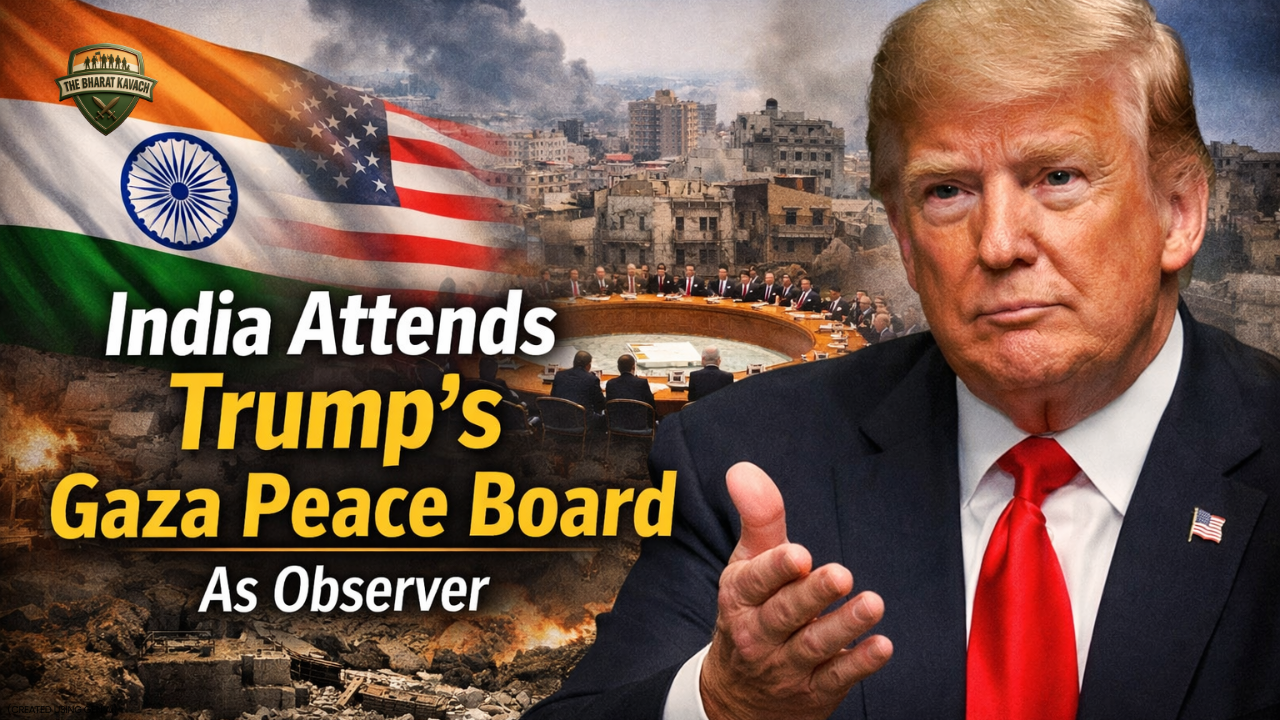
India on Thursday attended the inaugural meeting of US President Donald Trump’s Gaza Peace Board as an observer nation, marking a significant diplomatic development in the evolving Gaza reconstruction initiative. The meeting, held at the Donald J. Trump Institute of Peace in Washington DC, brought together representatives from 27 countries to discuss the future redevelopment and governance of the Gaza Strip following two years of conflict between Israel and Hamas. India was represented by Chargé d’affaires at the Indian Embassy, Namgya Khampa, but has not formally joined the Trump-led Gaza Peace Board.
The Gaza Peace Board is a new US-led multilateral mechanism designed to oversee the reconstruction of Gaza after the Israel–Hamas war. President Donald Trump has pledged $10 billion in American funding toward rebuilding infrastructure, housing, and public systems in the Gaza Strip. However, the structure of the Gaza Peace Board differs significantly from traditional UN-led frameworks. The US President retains veto authority over board decisions and may remain head of the body even after leaving office. Countries seeking permanent membership beyond a two-year term must contribute $1 billion, and reconstruction funding is explicitly tied to security compliance and governance conditions.
Members of the executive council of Trump’s Gaza Peace Board include US Secretary of State Marco Rubio, Jared Kushner, and World Bank President Ajay Banga. Participating nations include Saudi Arabia, the United Arab Emirates, Pakistan, Hungary, Argentina, Armenia, and Azerbaijan. The initiative has drawn global attention because it is widely viewed as a parallel structure to the United Nations. President Trump has previously stated that the Gaza Peace Board could “replace” or rival certain UN peace-building functions, reflecting broader US dissatisfaction with multilateral mechanisms in handling prolonged conflicts like Gaza.
India’s decision to attend the Gaza Peace Board meeting as an observer reflects its calibrated West Asia policy. New Delhi maintains strong defence ties with Israel, deep economic and energy partnerships with Gulf states such as Saudi Arabia and the UAE, and historical diplomatic support for the Palestinian cause. By participating as an observer rather than a permanent member, India preserves strategic flexibility while remaining engaged in discussions concerning Gaza reconstruction and regional stability. Notably, India did not attend the January 22 Davos ceremony where the Gaza Peace Board was first announced, suggesting that New Delhi is carefully evaluating the board’s long-term legitimacy and geopolitical implications.
The Gaza Peace Board
The creation of the Gaza Peace Board highlights a broader shift in US foreign policy under President Trump. Washington appears intent on exercising greater control over post-war reconstruction in Gaza, linking financial assistance directly to security reform and political restructuring. This model contrasts with UN-led humanitarian frameworks that rely on consensus-based diplomacy. By centralizing authority and tying funding to compliance benchmarks, the United States seeks to shape Gaza’s political and economic future while consolidating a bloc of aligned states in West Asia.
For India, the Trump Gaza Peace Board presents both opportunity and caution. Participation in Gaza reconstruction efforts could enhance India’s diplomatic footprint in West Asia and open avenues for infrastructure cooperation. At the same time, close association with a body perceived as challenging the United Nations could complicate India’s traditional support for multilateral institutions. India’s observer status therefore signals engagement without endorsement, maintaining balance amid shifting global power equations.
As the Gaza Peace Board begins its work, its success will depend not only on funding commitments but on regional acceptance, security stability, and political credibility. India’s presence at the inaugural meeting underscores its growing relevance in global diplomacy while reflecting its preference for strategic prudence. For now, New Delhi remains inside the conversation — but not yet fully invested in the structure of Trump’s Gaza reconstruction initiative.
