

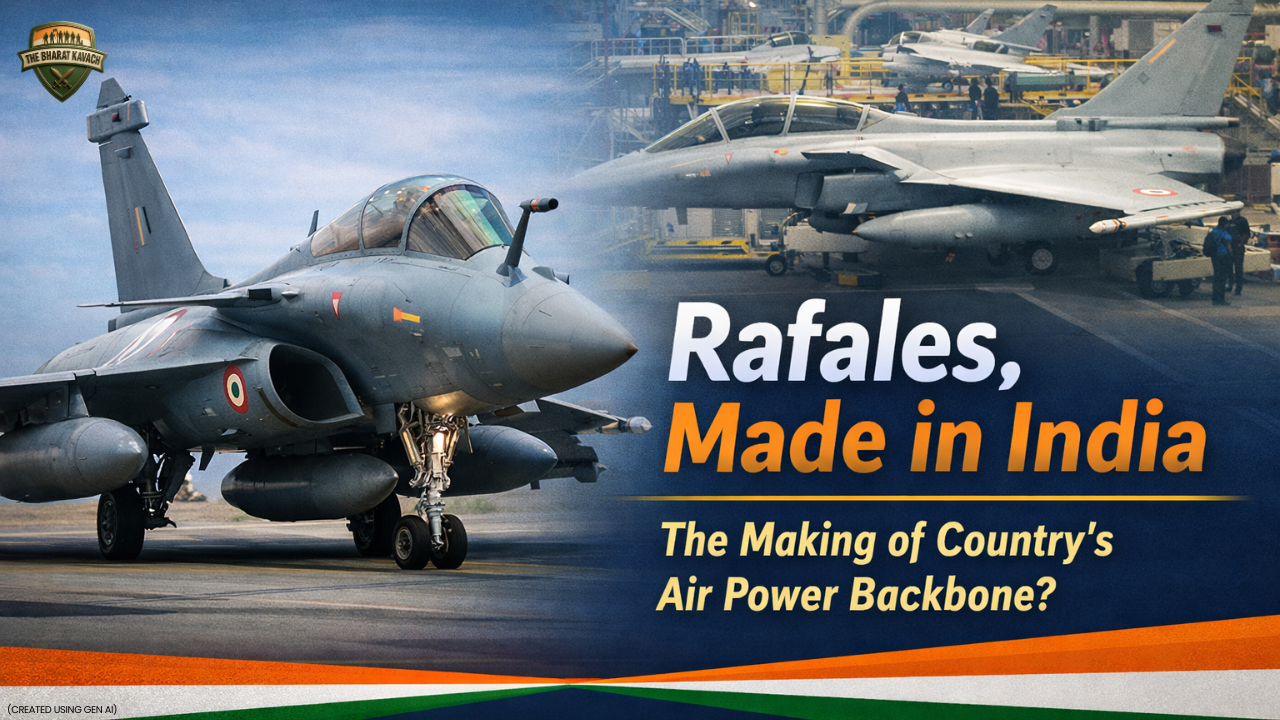
India has taken a decisive step that could shape the Indian Air Force for the next four decades. The Defence Acquisition Council, chaired by Defence Minister Rajnath Singh, has cleared the procurement pathway for 114 multi-role fighters under the Air Force’s long-pending MRFA requirement. The Dassault Rafale stands at the centre of this development.
But the significance of this move is not the number 114.
It is this: the majority of these aircraft are planned to be manufactured in India, with 50–60 percent indigenous content.
That transforms the conversation entirely.
This is not about importing aircraft to fill a temporary gap. It is about embedding a combat platform within India’s industrial and strategic architecture for the next 40 years.
From Buyer to Builder
Only around 20 aircraft are expected to arrive in fly-away condition. The remaining fighters are slated to roll out of Indian production lines.
If executed as envisioned, this would mark the first time Rafale production takes place outside France. More importantly, it would expand India’s aerospace ecosystem beyond assembly into deeper participation — structural components, systems integration, maintenance architecture, and supply chain localisation.
A 50–60 percent indigenous content target is not cosmetic. It signals an intent to reduce long-term dependence, strengthen domestic capability, and ensure lifecycle sustainability.
India has done this before with the Sukhoi Su-30MKI. That programme did not merely add aircraft; it created industrial depth. The difference now is that the technological threshold is higher and the strategic urgency sharper.
Why the Urgency Exists
The Indian Air Force today operates roughly 29 fighter squadrons against a sanctioned requirement of 42.
This shortfall is not abstract. It affects force posture and operational planning in a two-front contingency environment.
Legacy aircraft are steadily exiting service:
- Mikoyan-Gurevich MiG-21
- SEPECAT Jaguar
- MiG-29 (approaching structural ageing)
At the same time, regional threat perceptions have hardened. Air power cannot be regenerated quickly in a crisis. It must be built patiently, years in advance.
The estimated financial outlay — around ₹3.25 lakh crore — reflects not just aircraft acquisition, but weapons integration, training systems, maintenance infrastructure and long-term support.
Operational Confidence, Strategic Calculation
Recent operational experience has strengthened confidence in the platform. During Operation Sindoor, the Rafale’s precision-strike and survivability profile were publicly acknowledged by senior Air Force leadership.
Yet institutional decisions of this magnitude are rarely emotional. They are calculated assessments of performance, logistics, integration flexibility and upgrade potential.
A fleet that could eventually exceed 150 aircraft — counting the 36 already in service and the 26 naval variants ordered — would create doctrinal continuity, weapons standardisation and training cohesion across decades.
Bridging to the Future
India’s indigenous fifth-generation project, the HAL AMCA, remains years away from operational induction. The HAL Tejas programme continues to mature but cannot alone compensate for the immediate numerical deficit.
The 114-aircraft programme therefore serves a dual purpose: immediate stabilisation and long-term industrial strengthening.
Fly-away aircraft could begin induction around 2030, with domestically manufactured platforms following in phases. Finalisation will require negotiations on cost, configuration and technology transfer before Cabinet approval.
A 40-Year Decision
Air power decisions echo across generations. Pilots trained today will retire on aircraft inducted under this programme. Maintenance ecosystems created now will define readiness rates decades later.
If India successfully manufactures the bulk of these fighters at home, with meaningful indigenous content, it will not simply be expanding inventory. It will be anchoring its medium-weight fighter backbone in a domestically supported ecosystem.
That is what gives this development its gravity- the possibility that India is moving from being a large buyer of advanced air power to becoming a long-term builder of it. And that is a strategic shift worth noting.
