


In a shocking incident that has heightened security concerns across India, the Delhi Red Fort blast on November 10, 2025, claimed 13 lives and injured over 20 people. What initially appeared as a possible CNG or fuel tank rupture swiftly evolved into a terror probe, with authorities invoking the Unlawful Activities (Prevention) Act (UAPA) and suspecting a fidayeen (suicide) attack.
This terror attack in Delhi near the historic Red Fort has now been linked to a recently busted Faridabad terror module associated with Jaish-e-Mohammed (JeM) and Ansar Ghazwat-ul-Hind (AGuH). As investigations unfold, here’s a detailed look at the explosion, its aftermath, and the counterterrorism operation that may have triggered this desperate act.
The Red Fort Car Blast
The Delhi explosion November 2025 occurred at approximately 6:52 PM when a white Hyundai i20, stopped at a traffic signal near Gate No. 1 of the Lal Quila Metro Station, detonated in a high-intensity blast.
Eyewitnesses reported car fragments scattering up to 500 meters, igniting fires in nearby vehicles and creating scenes of chaos with mutilated bodies and thick smoke. Initially suspected to be a mechanical mishap, it soon became evident that this was a terror attack in Delhi — a deliberate act aimed at creating panic in the heart of the capital.
At least 13 people were killed and more than 20 injured, with charred remains suggesting three occupants in the vehicle. The car, a Haryana-registered Hyundai i20 (HR 26 CE 7674), bore no ground crater — pointing to a shift to a non-traditional explosive use.
Fire tenders brought the flames under control by 7:30 PM, while ambulances rushed victims to Lok Nayak Hospital. Delhi Police Commissioner Satish Golcha confirmed the blast’s severity, noting its proximity to the UNESCO World Heritage Site made it unprecedented in recent memory.

Nationwide Alert After Delhi Blast
The explosion sparked nationwide high alerts across airports, railway stations, and key monuments in Maharashtra, Uttar Pradesh, Haryana, and even at the Mata Vaishno Devi shrine.
Union Home Minister Amit Shah visited the site and the injured, promising a thorough investigation. Prime Minister Narendra Modi condemned the attack, vowing that “all those responsible will be brought to justice.” The NIA, NSG, and forensic teams are now leading the probe, with CCTV footage revealing the car was parked near Sunehri Masjid for nearly three hours before detonation.
The Blast Car Trail
Investigators discovered the car’s complex resale history — a deliberate attempt to obscure ownership. Originally registered to Mohammad Salman from Gurugram, the vehicle changed hands seven times, including an OLX sale just four days before the blast.
The ownership trail runs through Nadeem, a used-car dealer at Royal Car Zone in Faridabad’s Sector 37, to Aamir (or Amir Rashid), Tariq Ahmad Dar from Pulwama, and finally Dr. Umar Mohammad, a 36-year-old doctor from Pulwama employed at Al-Falah Medical College in Faridabad. CCTV footage shows Dr. Umar driving the vehicle hours before the explosion.
DNA tests are pending on the charred remains, but forensic teams suspect Dr. Umar was among the three occupants. This pattern of transactions and false registrations points to deliberate planning in the Delhi terror attack 2025.
The Faridabad JeM–AGuH Terror Module Bust
The tragedy is inextricably tied to a major counterterrorism breakthrough just hours before the blast — the busting of a white-collar JeM–AGuH terror module in Faridabad.
The operation began on October 19, 2025, after JeM posters threatening attacks surfaced in Srinagar’s Bunpora Nowgam area, leading to an FIR under UAPA, the Explosive Substances Act, and the Arms Act. Joint raids by J&K, Haryana, and Uttar Pradesh Police exposed a transnational network of radicalized professionals in touch with Pakistani handlers.
Eight operatives were arrested, including:
- Dr. Muzamil Shakeel (alias Musaib, 35, Pulwama; Al-Falah University faculty)
- Dr. Adil Ahmad Rather (alias Adeel, Kulgam)
- Dr. Shaheen Shahid (Lucknow)
- Arif Nisar Dar (Sahil)
- Yasir-ul-Ashraf, Maqsood Ahmad Dar (Shahid), Molvi Irfan Ahmad, and Zameer Ahmad Ahanger
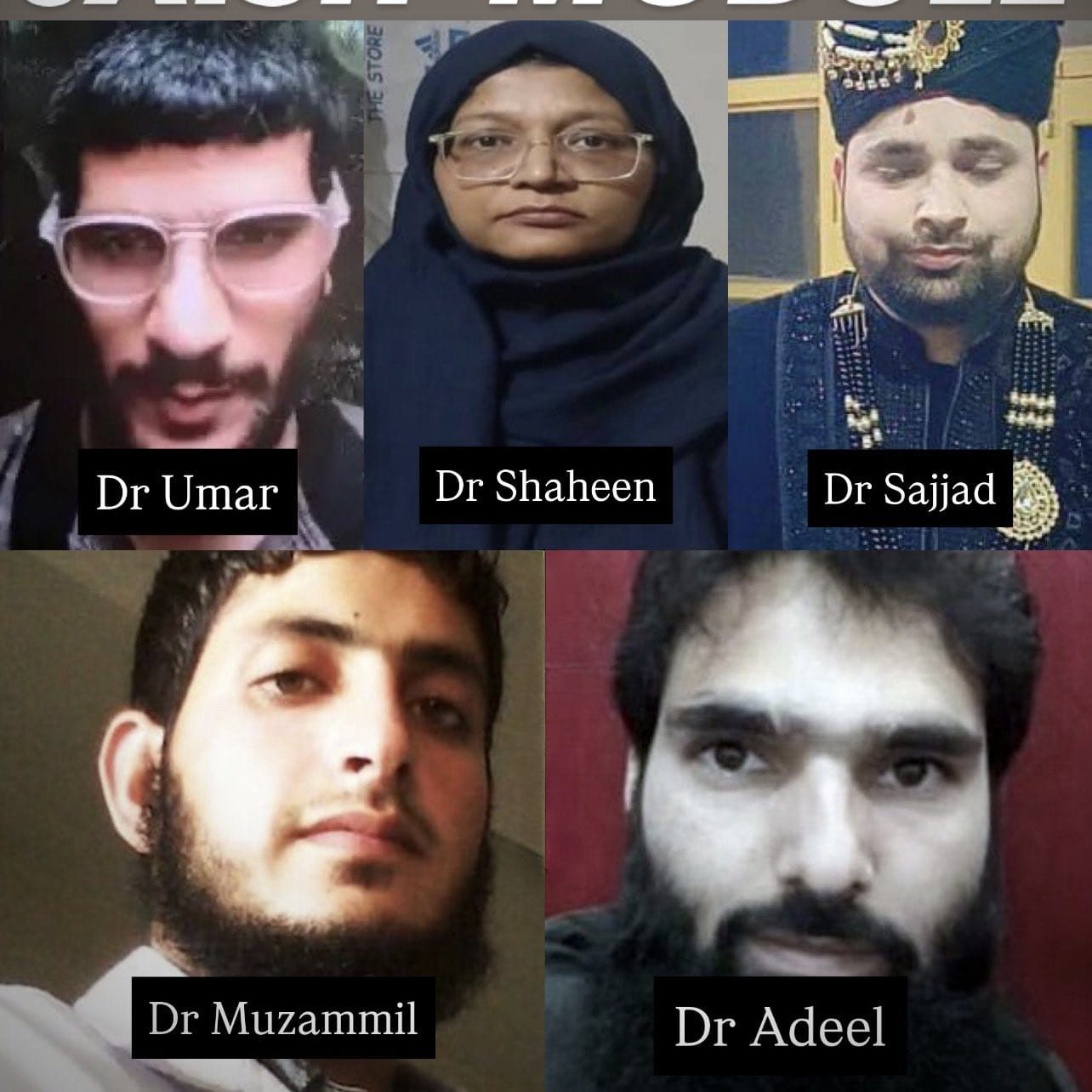
Raids on Dr. Muzamil’s residences in Dhauj and Dehar Colony led to one of the largest explosives seizures in recent years — nearly 2,900 kg of IED precursors, including ammonium nitrate, potassium nitrate, and sulphur, along with weapons like AK-56 rifles, Krinkov rifles, Beretta pistols, and detonation devices such as remote controls, circuits, and timers. It’s also noteworthy that Dr. Shaheen is suspected to be the head of Jaish-e-Muhammed’s Women wing in India.
In addition, agencies are now searching for a key suspect identified as Dr. Parvez, believed to be the brother of Dr. Shaheen Shahid. Parvez, who has reportedly gone underground following the Faridabad raids, is suspected of having coordinated logistics and digital communication for the JeM–AGuH network. His apprehension is expected to provide critical insights into the module’s broader reach and operational hierarchy.
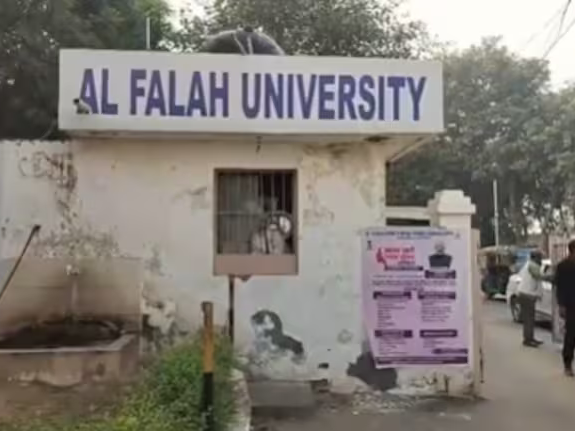
JeM–AGuH White Collar Terrorist Network
Investigators suspect the module used university labs at Al-Falah University for possible RDX synthesis, indicating the rise of “educated infiltrators” — highly skilled radicals exploiting academic spaces for terror operations in India.
Encrypted communication channels and digital funding routes tied these operatives to Pakistani handlers, marking a dangerous evolution in terrorism in India. Over 800 police personnel conducted searches across the university campus, exposing the network’s scale.
Forensic Links Between Red Fort Blast and Faridabad Seizures
Police sources indicate that initial findings point to ammonium nitrate, fuel oil, and detonators in the blast, mirroring the 350–360 kg of ammonium nitrate recovered in Faridabad, but final forensic reports are still awaited. The connection between the Faridabad module and the car blast at Red Fort remains suspected given the scale and impact of the incident.
Dr. Umar, reportedly an associate of Dr. Adil Rather, panicked after the module’s exposure and rigged the i20 for a desperate retaliatory strike in Delhi. Authorities believe the Faridabad module bust may have thwarted multiple large-scale attacks across North India but could not prevent this single tragedy.
NIA Probe and Expanding Crackdown
As of November 11, 2025, the National Investigation Agency (NIA) has officially taken over the case, coordinating with NSG and Delhi Police. Arrests have expanded to include Tariq Ahmad Malik (44, Pulwama), Aamir Rashid Mir (27), Umar Rashid (30), and three additional doctors from Al-Falah University.
Raids have also extended to Lucknow, linked to Dr. Shaheen Shahid’s family and JeM’s women’s wing activities. Authorities are tightening surveillance around academic institutions and digital payment networks used for recruitment and funding.
Delhi’s high alert remains in effect, with emergency helplines active for hospitals and families searching for missing relatives. This tragedy echoes the 2011 Delhi High Court bombing, reminding India of the ever-present threat of extremism.
As India mourns the victims of the Delhi Red Fort blast 2025, the incident stands as a grim reminder of the evolving nature of terrorism in India — more educated, networked, and deceptive.
Yet, it also highlights the success of Indian intelligence agencies and law enforcement in disrupting major terror modules before they strike. The recent crackdown and discoveries highlight how the timely raids averted broader threats but couldn’t prevent this tragedy. Faridabad Police Commissioner Satender Kumar Gupta praised the operation for dismantling a major network, with more revelations anticipated.
